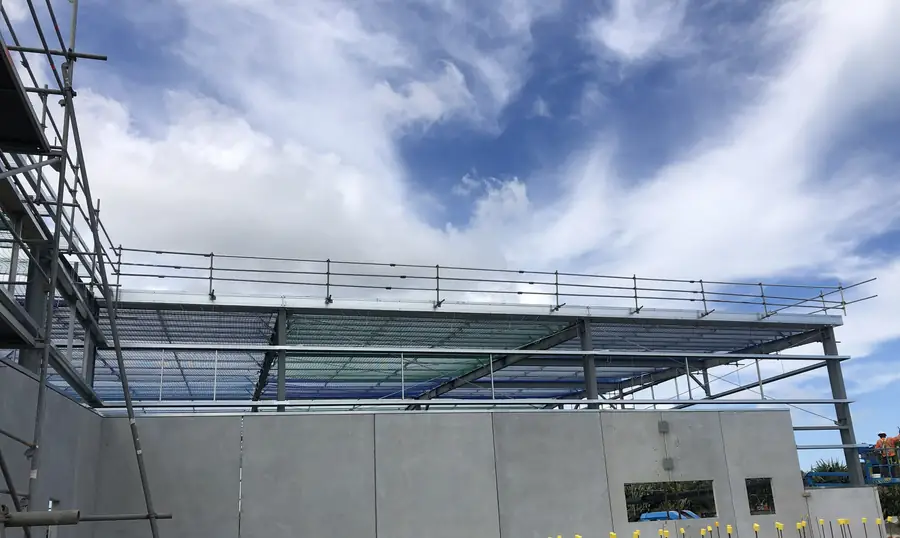
What roof edge protection is
A complete roof edge protection system has a top rail, a mid rail and a toeboard around every open edge, and often a working platform at the eaves. WorkSafe's working at height guidelines say proper edge protection needs guardrails, toeboards and a platform, and that edge protection should be designed and installed to the AS/NZS 4994 series of standards for temporary edge protection.
There are two common ways to provide it:
- Scaffold-based edge protection. A scaffold built up to the eaves with a working deck and guardrails above the gutter line. It suits re-roofs and jobs where trades also need to work on the walls or gutters.
- Proprietary edge protection systems. Engineered guardrail posts and rails fixed at the roof edge. They suit roof repairs where no one needs a platform at the walls.
WorkSafe's guidelines say not to use single-pole edge protection, because those systems lack the strength of designed systems or full scaffolds and usually have no toeboard or platform. We don't use them.
Roof edge protection in NZ: when roof work needs it
WorkSafe's guidelines, updated in August 2026, say there is no minimum height for working at height in New Zealand: any fall risk has to be managed. WorkSafe recommends physical barriers or fall restraint for any potential fall over 1 m. For roofing work on a house, its guidelines give scaffolding with full edge protection (top rail, mid rail and toeboard) as the control.
Our guide to edge protection requirements in NZ covers the rules in more detail, including guardrail heights and what happens above 5 m.
Roof pitch and edge protection
The steeper the roof, the more the edge protection has to do. WorkSafe's guidelines set out these points for roofs:
| Roof pitch | Guidance |
|---|---|
| Up to 25° | Edge protection designed and installed to the AS/NZS 4994 series, with guardrails and toeboards. |
| Over 25° | Edge protection should be system-rated and fitted with infill panels, so people, tools and materials can't slip through. |
| Over 35° | Edge protection should be designed specifically for the roof. |
Where scaffold is used as edge protection, WorkSafe says the gap between the work deck and the gutter line should be no more than 100 mm to 200 mm. Gable ends need protection that runs all the way to the apex.
Roof edge protection or full scaffolding?
Both protect the roof edge. The difference is whether anyone also needs to work from a platform at the walls or gutters.
| Job | What usually works |
|---|---|
| Full re-roof | Scaffold around the house with a deck at the eaves and guardrails above the gutter line, so roofers can work the whole roof and pass materials safely. |
| Gutter, fascia or spouting replacement | Scaffold along the affected sides, with the deck at gutter height. |
| Roof repairs or a small section of roof | Edge protection along the edges near the work, or scaffold on one side. |
| Painting walls and roof | Full scaffold, so painters reach walls, eaves and roof from the same setup. |
| New build roof stage | Scaffold around the frame with edge protection, often with safety nets inside the frame. |
For more on planning scaffold for a new roof, read scaffolding for roofing.
What a roof edge protection setup includes
A scaffold-based roof edge protection setup is made up of these parts:
| Part | What it does |
|---|---|
| Base plates and sole boards | Spread the load into the ground, levelled for slopes. |
| Standards, ledgers and transoms | The uprights and horizontals that form the scaffold frame up to the eaves. |
| Working deck | A platform at gutter height, within 100 mm to 200 mm of the gutter line. |
| Top rail and mid rail | Guardrails 900 mm to 1,100 mm above the deck, with a mid rail halfway. |
| Toeboards | Stop tools and materials sliding off the deck. |
| Infill panels | Mesh or panels between the rails on roofs steeper than 25°. |
| Ties | Fix the scaffold to the building so it stays stable. |
| Access | A safe way up to the deck for the roofers. |
How we install roof edge protection
- Site check. We look at the roof pitch, the length of each edge, gables and dormers, the ground and where trucks can unload.
- Base and frame. Base plates and sole boards go down, and the scaffold is built up to eave height.
- Deck and rails. The working deck goes in at gutter height, then the top rails, mid rails and toeboards. Roofs over 25° get infill panels.
- Gable ends. Protection follows the roofline right up to the apex, with no gaps at the gable ends.
- Handover. The roofer starts work behind the rails. If a section needs to move, tell us before the work goes ahead.
- Dismantle. Once the roof is finished, we take it all down and clear the site.
Roof edge protection cost
Roof edge protection is priced on the job, not off a price list. These are the things that change the price most:
- Perimeter length. How many metres of roof edge need protecting.
- Height and storeys. A two-storey eave needs more scaffold under it than a single-storey one.
- Roof pitch. Roofs over 25° need infill panels; very steep roofs need a specific design.
- Gables and roof shape. Gable ends, dormers and hips add rails and corners.
- Access and ground. Slopes, garden beds and tight driveways add set-up time.
- How long it stays up. The hire period agreed with the roofer.
As a published guide, NZ Tradie Tools' 2026 cost table lists roof scaffold with edge protection on a house at $2,500 to $5,000. Your quote from us is free and based on your roof, so send photos of each side and the roof shape.
Edge protection hire with Itus
We install the edge protection, your roofer works behind it for the agreed period, and we dismantle it when the roof is finished. If the roofer needs a section moved or the job changes, tell us before the trades go ahead so we can plan the change.
Edge protection is one of our core services. Read more about our edge protection for residential, commercial and industrial sites.
Roof edge protection in Auckland and Waikato
We install roof edge protection across Auckland and Waikato from our base in Waiuku, South Auckland, including the North Shore, West Auckland, South Auckland and Hamilton.
Your questions
How high does roof edge protection need to be?
WorkSafe's guidelines say guardrail systems should be between 900 mm and 1,100 mm high, with a mid rail halfway between the platform and the top rail, plus a toeboard where tools or materials could fall.
Do I need edge protection for a single-storey re-roof?
WorkSafe's guidelines set no minimum height and recommend physical barriers for any fall over 1 m, which takes in most single-storey roofs. Edge protection or scaffold is the usual answer.
Is edge protection cheaper than scaffolding?
Often, for roof-only work, because there is less equipment. If trades also need to work on walls or gutters, a scaffold with edge protection does both jobs.
How long can edge protection stay up?
As long as the roof work needs. We agree the hire period with you or your roofer and you can extend it if the job runs over.