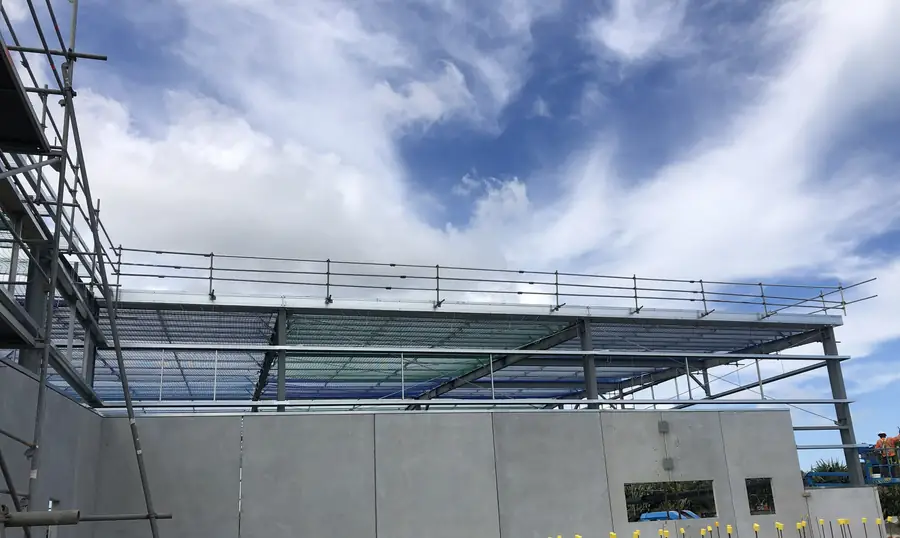
The short answer
WorkSafe's good practice guidelines, Working at height in New Zealand, were last updated on 7 August 2026. The key points for roof work:
- There is no minimum height threshold. Any fall risk from any height must be managed.
- WorkSafe recommends any potential fall over 1 m is managed with physical barriers or fall restraint.
- Edge protection should be designed and installed to the AS/NZS 4994 series of standards for temporary edge protection.
- For roofing work on a house, WorkSafe's guidelines give scaffolding with full edge protection (top rail, mid rail and toeboard) as the control.
If you've heard of a "3 metre rule", it no longer reflects WorkSafe's guidance.
When edge protection is needed
WorkSafe's guidelines list places where a fall could happen and edge protection should be used, including:
- the perimeters of working places, such as roof edges and open sides of floors;
- openings, such as stairwells and skylight voids;
- areas with brittle material that can't safely take a person's weight.
This applies to new builds, re-roofs, roof repairs, gutter work and maintenance alike. A one-day job on a single-storey roof is still work at height.
What edge protection must include
WorkSafe's guidelines describe proper edge protection as guardrails, toeboards and a platform. For general guardrail systems, they say:
| Part | Guidance |
|---|---|
| Top rail | Between 900 mm and 1,100 mm above the working platform. |
| Mid rail | A single mid rail halfway between the platform and the top rail. |
| Toeboard | Installed where tools or objects could be dropped. Timber toeboards at least 90 mm high. |
| Sloping roof edges | Guardrails on a sloping roof have specific design requirements, because workers can fall against them harder. |
Temporary guardrails should generally be built from a proprietary metal tube and clip system.
Types of edge protection
Scaffold-based edge protection
A scaffold built to the eaves with a working deck and guardrails above the gutter line. It protects the roof edge and gives trades a platform for gutters, fascias and walls. This is what we usually install for re-roofs; see roof edge protection.
Proprietary edge protection systems
Engineered posts and rails clamped or fixed at the roof edge. They suit roof-only work where nobody needs a platform at the walls.
Timber guardrails
WorkSafe's guidelines allow temporary timber guardrails if they have a top rail 900 mm to 1,100 mm above the working surface, a mid rail halfway, a toeboard at least 90 mm high, no defects, and rails of at least 90 mm x 45 mm with toeboards of at least 150 mm x 25 mm.
Permanent edge protection
Parapet walls and permanent guardrails designed into a building. WorkSafe encourages designers to include them so maintenance workers aren't exposed later.
Single-pole systems: not recommended
WorkSafe's guidelines say not to use single-pole edge protection. These systems lack the strength of designed systems or full scaffolds, usually have no toeboard or platform, often can't withstand a worker falling against them, and putting them up can mean working unprotected.
Roof pitch rules
| Roof pitch | What the guidelines say |
|---|---|
| Up to 25° | Edge protection to the AS/NZS 4994 series, with guardrails and toeboards. |
| Over 25° | Edge protection should be system-rated and fitted with infill panels to stop people, tools, equipment and materials falling through. |
| Over 35° | Edge protection should be designed specifically for the roof. |
Gable ends
Edge protection should be installed first so it is continuous, follows the roofline to the apex (including gable ends) and has top rails, mid rails and toeboards where needed. It should not stop short of the apex, and work should not rely only on harnesses where full edge protection is reasonably practicable.
When scaffold is used as edge protection
When scaffold provides the edge protection, the scaffolding rules apply too. WorkSafe's guidelines say:
- Scaffolds should comply with WorkSafe's Scaffolding in New Zealand guidelines or the AS/NZS 1576 series.
- The gap between the work deck and the gutter line should be no more than 100 mm to 200 mm.
- Scaffolds from which a person or object could fall more than 5 m should be erected, altered and dismantled by, or under the direct supervision of, a person with an appropriate Certificate of Competence.
- Work with a risk of falling 5 m or more must be notified to WorkSafe as particularly hazardous work at least 24 hours before it starts.
- Scaffolds should be regularly inspected, with a scaffold register kept on site as the record.
Inspecting and maintaining edge protection during the job
Edge protection only works if it stays complete. WorkSafe's guidelines say scaffolds should be regularly inspected to make sure they are still compliant and fit for purpose, with a scaffold register kept on site as the record.
On a roof job, that means:
- checking rails, toeboards and infill panels each day before work starts;
- checking again after strong wind or heavy rain, or if anything has been knocked or loaded against the rails;
- never removing a rail to pass materials through, and asking your scaffolder to make any change;
- recording inspections in the register.
Choosing roof edge protection for a house
| Situation | What usually suits |
|---|---|
| Full re-roof, single or two storey | Scaffold to the eaves with a deck and guardrails, so roofers can work the whole roof and pass materials. |
| Gutters, fascias or painting as well as roofing | Scaffold, because trades need a platform at the walls too. |
| Short roof repair, low pitch | A proprietary edge protection system along the affected edges. |
| Roof over 25° | System-rated edge protection with infill panels; over 35°, a specific design. |
Our roof edge protection page explains the options, parts and cost in more detail.
Edge protection checklist before roof work starts
- Every open roof edge, gable end and opening has protection, running to the apex.
- Guardrails have a top rail at 900 mm to 1,100 mm, a mid rail and toeboards.
- Roofs over 25° have system-rated edge protection with infill panels.
- Any scaffold deck sits no more than 100 mm to 200 mm below the gutter line.
- Skylights and brittle roof areas are protected or covered.
- If a fall of 5 m or more is possible, WorkSafe has been notified at least 24 hours ahead.
- The scaffold has been handed over and its inspection record is on site.
- Everyone knows who to call if a rail needs moving.
Need a hand planning it? Our edge protection service covers residential, commercial and industrial work, and our scaffolding guide walks through planning a whole project.
Your questions
How high does edge protection need to be in NZ?
WorkSafe's guidelines say general guardrail systems should be between 900 mm and 1,100 mm high, with a mid rail halfway and a toeboard where objects could be dropped.
Can you work on a roof without edge protection?
WorkSafe says any fall risk must be managed and recommends physical barriers or fall restraint for falls over 1 m. For roofing on a house, its guidelines give scaffolding with full edge protection as the control.
Is there still a 3 metre rule?
No. WorkSafe's current guidelines say there is no minimum height threshold for working at height in New Zealand.
When does roof work need to be notified to WorkSafe?
Work with a risk of falling 5 m or more must be notified to WorkSafe as particularly hazardous work at least 24 hours before it starts.