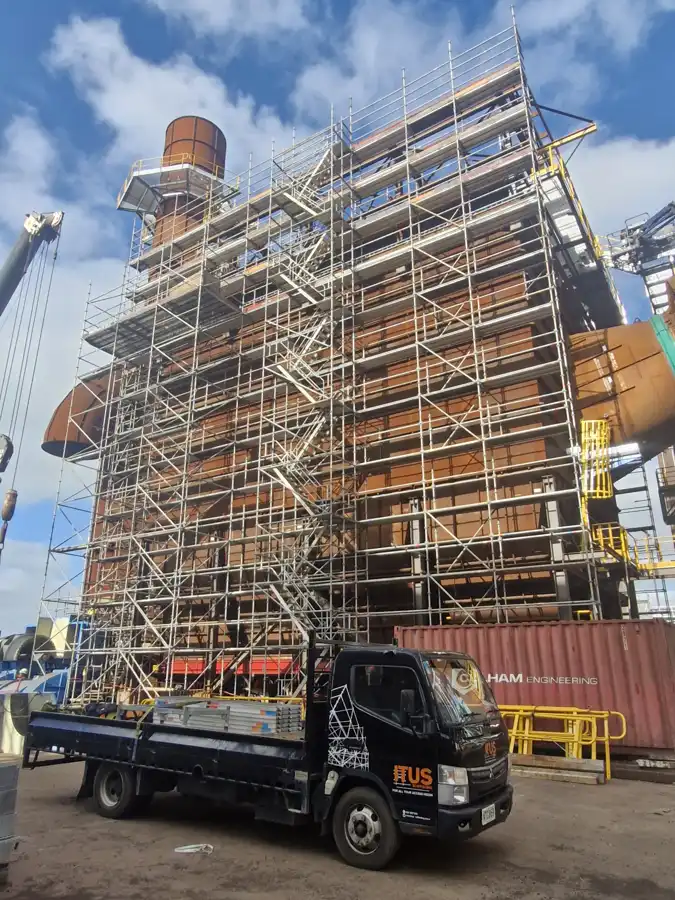
Industrial scaffolding work we plan for
Industrial jobs often happen in places that keep running around the work. We plan scaffold for:
- Industrial and manufacturing sites. Access to buildings, structures and plant.
- Maintenance shutdowns. Scaffold ready before the shutdown starts, altered as work moves, and removed promptly after.
- Plant areas. Access around tanks, stacks, pipework and equipment.
- Maintenance programmes. Reliable access for facilities teams and contractors working to fixed schedules.
Industrial scaffolding is part of our commercial scaffolding service.
Planning scaffolding for a shutdown
A shutdown has a fixed window, so the scaffold has to be ready on time and changes have to be planned. We work through:
- Scope. Which equipment and areas need access, at what heights, and for which trades.
- Sequence. What can be built before the shutdown, what must wait until plant is isolated, and the order the trades work in.
- Alterations. Where the scaffold will need to change as work moves, so it doesn't hold up the job.
- Loading and access points. Where materials come in, where people get on and off, and routes that must stay clear.
- Dismantling. How quickly the scaffold must come down for the plant to restart.
Access around plant and equipment
Plant areas bring tight spaces, uneven ground, pipe racks and equipment that can't be moved. Drawings, photos and a site walk-through let us plan the scaffold around them. Tell us about anything hot, live, vibrating or moving near the work.
Safety on industrial sites
We approach every setup with health and safety front of mind. We are a Site Safe member (for more than five years) and a SARNZ member, and our scaffolding inventory is ISO certified and properly maintained.
WorkSafe's working at height guidelines say scaffolds should comply with Scaffolding in New Zealand or the AS/NZS 1576 series, that scaffolds over 5 m should be erected by or under a person with a Certificate of Competence, that work with a risk of falling 5 m or more must be notified to WorkSafe at least 24 hours ahead, and that scaffolds should be inspected regularly with a register kept on site.
Tell us your site's induction, permit-to-work and isolation requirements when you enquire, so we can plan for them.
Height rules for industrial scaffolding
WorkSafe's Working at height in New Zealand guidelines (updated August 2026) set out what applies on industrial sites:
| Topic | What the guidelines say |
|---|---|
| Minimum height | There is none. Any fall risk from any height must be managed, and physical barriers or fall restraint are recommended for falls over 1 m. |
| Standards | Scaffolds should comply with Scaffolding in New Zealand or the AS/NZS 1576 series. |
| Over 5 m | Scaffolds from which a person or object could fall more than 5 m should be erected, altered and dismantled by, or under the direct supervision of, a person with an appropriate Certificate of Competence. |
| Notification | Work with a risk of falling 5 m or more must be notified to WorkSafe as particularly hazardous work at least 24 hours before it starts. |
| Guardrails | Between 900 mm and 1,100 mm high with a mid rail halfway, plus toeboards where tools or objects could drop. |
| Inspection | Scaffolds should be regularly inspected, with a scaffold register kept on site. |
| Trained people | Scaffolds should be erected, altered and dismantled by trained workers with experience of that type of scaffold. |
More detail on guardrails and roof edges is in our guide to edge protection requirements in NZ.
Industrial scaffolding cost
Industrial jobs are quoted on scope rather than a set rate. As a published reference point, NZ Tradie Tools' 2026 cost table lists commercial scaffolding at $25 to $50 per m2 erected. On industrial sites, these things move the price most:
- Height and area. How much scaffold face or platform the work needs.
- Duration. A short shutdown window or a long maintenance programme.
- Alterations. How often the scaffold must change as work moves.
- Working hours. Builds and dismantles outside normal hours to fit a shutdown.
- Site rules. Inductions, permits, isolations and exclusion zones.
- Extras. Edge protection, safety nets or shrink-wrap containment.
Send us the scope, drawings and dates and we'll price the job.
Edge protection, safety nets and containment
Industrial jobs often need more than a platform. We also provide edge protection for roofs and open edges, safety nets, and shrink wrapping for weather protection and containment around scaffold.
Industrial scaffolding in Auckland and Waikato
We work across Auckland and Waikato from our base in Waiuku, South Auckland, including South Auckland's industrial areas and sites around Hamilton.
What to send for an industrial quote
- The site address and the areas or equipment that need access.
- Drawings, photos and heights.
- Shutdown dates, working hours and how long access is needed.
- Which trades will use the scaffold, and the loads they'll bring (materials, tools).
- Site rules: inductions, permits, isolations, exclusion zones and a site contact.
If you're weighing scaffold against powered access for maintenance, read scaffolding vs scissor lift.
Your questions
Do you scaffold for maintenance shutdowns?
Yes. We plan scaffold to be ready before the shutdown starts, change it as the work moves and remove it promptly afterwards.
Can you work to our site's safety rules?
Yes. Tell us your induction, permit and isolation requirements when you enquire and we'll plan the job around them.
Do you cover industrial sites in Waikato?
Yes. We cover Auckland and Waikato from our South Auckland base.
Can you provide containment as well as access?
Yes. Our shrink wrapping can enclose scaffold for weather protection and containment.