Part of our scaffolding guide for planning a project.
What a temporary roof is
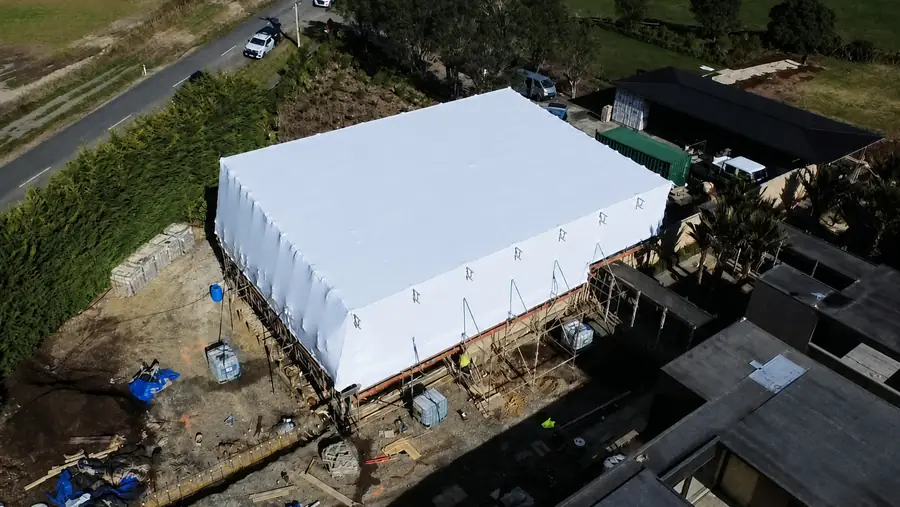
A temporary roof sits above the building on the scaffold. It is sheeted so rain runs off it instead of into the house, and the roofers work underneath it. Once the new roof is on and watertight, the cover comes off and the scaffold is dismantled.
On houses, the cover is usually shrink wrap: a heavy plastic film fixed to the scaffold and shrunk tight with heat, so it seals around the frame. Our shrink wrapping and weather protection service covers enclosures around or over scaffold.
Types of temporary roof cover
| Option | How it works | Best for |
|---|---|---|
| Shrink wrap over a scaffold roof frame | Film fixed over a frame on the scaffold and heat-shrunk into a tight, sealed cover. | Re-roofs and reclads on houses, where the roof will be open for days or weeks. |
| Tarpaulins tied to the scaffold | Tarps lashed to the scaffold or roof. | Short, emergency cover. They flap, let water through at joins and need re-tying after wind. |
| Engineered temporary roof systems | Purpose-built beam and sheet systems on the scaffold. | Large spans and commercial buildings. |
When a job needs a temporary roof
- Re-roofs in wet months. When the old roof comes off, the ceiling and insulation are exposed to the next shower.
- Occupied homes. If the family stays in the house during the work, keeping the inside dry matters even more.
- Reclads and leaky home repairs. Shrink wrap around and over the scaffold keeps rain off exposed framing while it dries and is repaired.
- New builds waiting for the roof. A cover lets interior trades start before the roof is finished.
Planning the roof job itself? Read scaffolding for roofing and roof edge protection.
How a temporary roof scaffold is planned
A temporary roof is built on the scaffold, so it's planned with it. These are the things we look at:
- Span. How wide the roof is from eave to eave decides how the cover is framed and supported.
- Height above the ridge. Roofers need room to work under the cover and to lift materials.
- Wind. A covered scaffold catches the wind like a sail. Exposure, ties and how the cover is fixed all depend on the site.
- Water run-off. The cover needs a fall so rain runs off and doesn't pond.
- Access and materials. How roofing materials get up to the roof and old roofing comes down.
- Edge protection. Guardrails around the roof edge are still needed under the cover; see edge protection requirements in NZ.
Design considerations and wind loads
An open scaffold lets the wind blow through it. Once it is wrapped or roofed, the cover becomes a solid surface the wind pushes and lifts, like a sail. That changes how the scaffold has to be built:
- More ties and bracing. A covered scaffold needs to be held to the building more firmly than an open one.
- Uplift on the roof. Wind passing over a cover tries to lift it, so the roof frame and its fixings must hold it down.
- Span and support. The wider the gap between supports, the stronger the roof frame needs to be. Large spans and commercial covers are usually engineer-designed.
- Exposure. Hilltop, coastal and open rural sites see stronger gusts than sheltered suburban streets.
- Water and ponding. A flat cover can collect water, which adds weight. A fall in the cover lets rain run off.
Tell us where the house is and how exposed it is, and we'll plan the scaffold and cover together.
How a shrink-wrapped temporary roof goes up
- Scaffold first. The scaffold goes up around the house with edge protection at the eaves.
- Roof frame. A frame is built on the scaffold above the ridge, high enough for the roofers to work underneath.
- Cover. Shrink wrap film is laid over the frame and fixed to the scaffold.
- Shrink and seal. The film is heat-shrunk tight and the joins are sealed so rain runs off.
- Access. Openings are planned so materials can come in and old roofing can go out.
- Removal. When the new roof is watertight, the cover comes off and the scaffold is dismantled. We recycle shrink-wrap materials where possible.
Re-roofing without a temporary roof
Not every re-roof needs a full cover. In settled weather, roofers often strip and re-sheet one section at a time, so only a small area is ever open, and cover it overnight. This works best for short jobs on simple roofs. A full temporary roof makes more sense when the job will take weeks, the weather is unsettled, the family is living in the house, or the ceiling and insulation would be hard to dry out.
Temporary roof scaffolding cost
A temporary roof is priced on top of the scaffold the job already needs. What changes the cost:
- Roof area and span. Larger and wider roofs need more frame and more cover.
- Height. Two-storey homes need more scaffold to support the cover.
- Roof shape. Hips, valleys and multiple roof levels add framing.
- How long it stays up. The hire period for the scaffold under it.
- Exposure. Windy sites can need more ties and fixings.
- Walls as well as roof. Wrapping the sides too (common on reclads) adds film and labour.
For the scaffold itself, our guide to how much scaffolding costs for a house gives published NZ ranges. We quote temporary roofs for free once we've seen photos of the house and roof.
Shrink wrap or tarps?
Tarps are fine for a few hours of emergency cover. For a roof that will be open for days, shrink wrap gives a tight, sealed cover that doesn't flap or need re-tying after every gust. It also lets light through, so it's easier to work under. We recycle shrink-wrap materials where possible once the job is done.
Your questions
How long can a temporary roof stay up?
As long as the roof work needs. Tell us how long the roof will be open and we'll plan the cover and scaffold hire for that period.
Is a shrink wrap roof waterproof?
A sealed shrink wrap cover sheds rain. It is fixed to the scaffold and heat-shrunk tight, which is what keeps water out at the joins.
Do I need a temporary roof for a re-roof?
Not always. For a short job in settled weather, roofers may open small sections at a time. For longer jobs, occupied homes or wet months, a cover protects the house.
Can you wrap the walls too?
Yes. For reclads and leaky home repairs we can wrap around and over the scaffold to enclose the whole job.