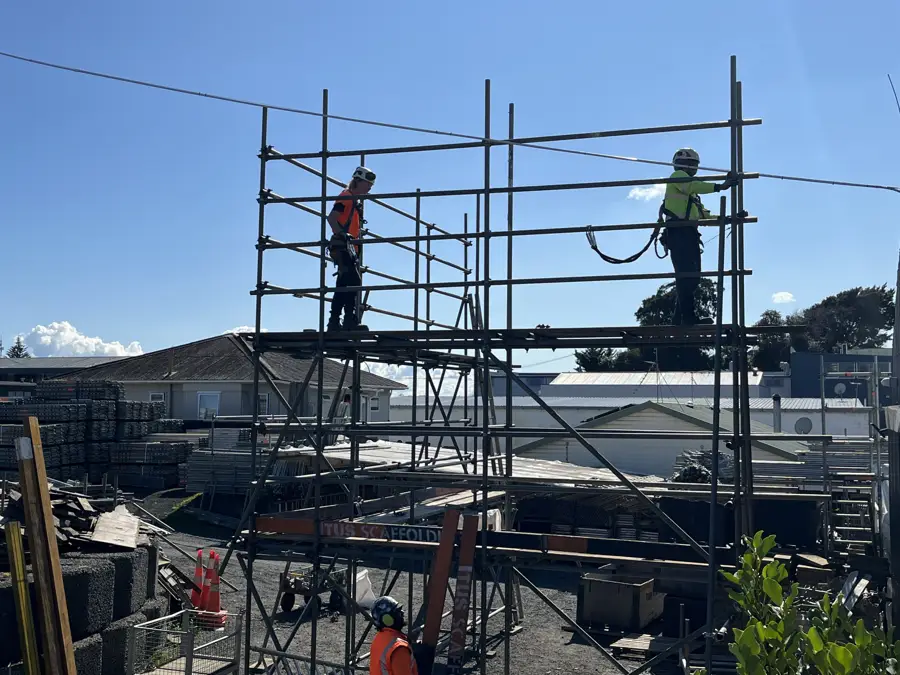
Part of our scaffolding guide.
Access to the job and working at the job
A ladder used to reach a scaffold platform has a different role from a ladder used as the place to work. Be clear which you mean when preparing a brief. The complete arrangement needs to address both reaching the work and carrying it out.
Our mobile scaffolds service supports maintenance and changing work areas. For work along a home’s exterior, discuss residential scaffolding and the elevations that need access.
Questions that help compare the options
| Question | Why it matters |
|---|---|
| How long will it take? | Include preparation and finishing, not just the main action. |
| What do your hands need to do? | Explain the tools, force and material handling involved. |
| How wide is the work area? | Repeated reaching or repositioning changes the task and exposure. |
| What is below and nearby? | Ground, doors, traffic and other people all affect the arrangement. |
| Who will use the equipment? | Suitability, competence and instructions need to be part of the decision. |
Do not treat a short task or low height as automatically free of fall risk. The choice needs to suit the actual work and conditions.
Compare the whole job in practical examples
Preparing and painting an upper wall
The task may involve washing, scraping, repairs and several coats across a broad surface. Describe all stages and the area to cover when discussing a platform arrangement. Our painting access guide helps organise that brief.
A small inspection or adjustment
Describe the work, duration, hand use and surface before selecting equipment. If the task develops into a longer repair, reassess the access rather than continuing with an arrangement chosen for a different job.
Avoid solving a reach problem by improvising
Tell us if an obstruction or offset makes the work difficult to reach. Do not add a ladder, box or other makeshift height to a scaffold platform. The responsible team should assess the arrangement when the work position differs from the agreed setup.
Use our working-height guide to describe the task location, platform level and surrounding space separately. Include photos taken from a safe position.
Make your access enquiry task-specific
- Name the work, including preparation and finishing.
- Describe the height and width of the area to reach.
- List the tools, materials and people involved.
- Show the ground and nearby activity in photos.
- Give the likely sequence and duration.
- Explain any obstruction or change of work position.
That information helps us discuss a scaffold arrangement with you. Once the scope is clearer, the mobile access quote checklist helps you ask about configuration, logistics and the hire period.
Your questions
Does a small job always suit a ladder?
No single equipment choice suits every small job. Consider the task, duration, hand use and site conditions before deciding.
Is a ladder used to access scaffolding the same as working from one?
No. Reaching a platform and using a ladder as a work position are different tasks. Discuss both the access route and the work arrangement with the responsible team.